


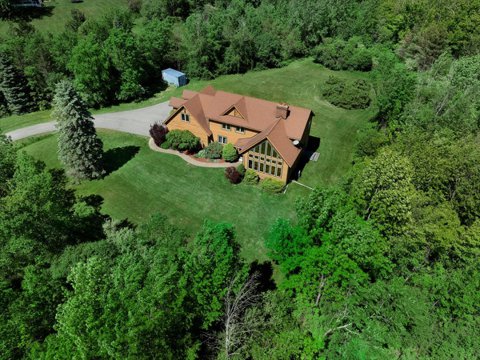
Almost every veteran I sit down with asks the same thing first: "If it's zero down, what do I actually need to bring to closing?" It's a fair question. A VA loan is one of the best tools a buyer can have, but "no down payment" does not mean "no cost." Here is what buying with a VA loan really costs in Albany, Saratoga, Schenectady and Rensselaer counties, with real numbers you can plan around. (Quick refresher: a VA loan is a mortgage from a regular lender that VA partly guarantees, so there is no down payment and no monthly mortgage insurance. The VA rules are national. The New York costs on top are what most online calculators miss.)
What is the VA funding fee in 2026?
The funding fee is a one-time charge paid to VA. It is a percentage of the loan amount, not the price, and you can roll it into the loan instead of paying it in cash. These rates have been in effect since April 7, 2023, per VA.gov (page updated October 5, 2026).
| Down payment | First use | After first use |
|---|---|---|
| Less than 5% | 2.15% | 3.3% |
| 5% or more | 1.5% | 1.5% |
| 10% or more | 1.25% | 1.25% |
Who pays nothing: veterans who receive VA compensation for a service-connected disability (or are eligible for it but get retirement or active-duty pay instead), surviving spouses who receive Dependency and Indemnity Compensation, service members with a pre-discharge rating before closing, and active-duty members with a Purple Heart. On a $375,000 loan, that exemption alone saves $8,062.50.
Is there a VA loan limit in Albany, NY and the Capital Region?
If you have your full VA entitlement, there is no VA loan limit. VA says plainly that you don't have a loan limit as long as you qualify and the appraisal supports the price. Your lender still decides how much you can borrow.
If part of your entitlement is tied up in another VA loan you still have, the county loan limit comes back into play. For 2026, the baseline limit for a one-unit home is $832,750 (FHFA, announced November 25, 2025), which covers Albany, Saratoga, Schenectady and Rensselaer counties. With reduced entitlement, you may need a down payment on a higher-priced home. Ask your lender to run the numbers from your Certificate of Eligibility.
Here is what a VA buyer can shop for right now, by asking price:
| Asking price | Albany County | Saratoga County |
|---|---|---|
| Under $300,000 | 200+ | 82 |
| $300,000 to $449,999 | 175 | 91 |
| $450,000 to $599,999 | 81 | 129 |
| $600,000 and up | 98 | 200+ |
Active single-family homes, condos, townhouses and multi-family homes listed on Global MLS through our site's search, November 16, 2026. Asking prices, not sale prices. "200+" means the search tool caps the count at 200.
In the $300,000 to $449,999 range, the average asking price was about $368,000 in Albany County and about $378,000 in Saratoga County. You can search every listing or browse by area on our Albany County and Saratoga County pages.
What closing costs do VA buyers pay in New York?
Here is the list I walk veterans through. Some of these are the same for every buyer in New York. A few are specific to VA.
- New York mortgage tax. New York taxes the mortgage itself when it is recorded. Outside the New York City transit district, the state rates add up to $1.00 per $100 of loan. On a one- or two-family home, the lender pays the 25-cent "special additional" part by law, so the buyer's share is about 0.75% of the loan (NYS Tax Law Section 253). Ask your attorney to confirm the exact figure for your town.
- Your attorney. In the Capital Region, buyers and sellers each hire their own real estate attorney. Fees vary, so get a quote early.
- Title insurance and recording fees. The lender requires a title policy, and the county clerk charges to record the deed and mortgage.
- Lender charges and the VA appraisal. Origination fees, discount points if you choose to buy down your rate, the credit report and the VA appraisal fee.
- Prepaids. Your first year of homeowners insurance and a starting balance for property taxes in your escrow account. With school and town or county tax bills due at different times of year, this number depends a lot on your closing date.
- Earnest money deposit. This is the good-faith deposit you put down once your offer is accepted and the contract is signed. VA does not require one, but most sellers expect it, and the amount is negotiable. In the Capital Region it is typically held in escrow by the listing broker or the seller's attorney, never by the seller. It is not an extra cost: at closing, it is credited toward what you owe. Whether you get it back if the deal falls through depends on your contract, so read the contingencies with your attorney.
- Home inspections. These are paid by you, before closing, and are separate from the VA appraisal (the appraisal is not an inspection). A general home inspection in the Albany area runs about $300 to $710 depending on the size of the home, and a pest (termite) inspection about $130 to $180. Depending on the house, you may also want radon testing, a well water test, a septic inspection, or a structural engineer for foundation concerns. Prices for these vary by company and property, so ask your inspector for a bundled quote.
A cost you usually will not see as a buyer: New York's real estate transfer tax of 0.4% is customarily paid by the seller in the Capital Region. The 1% "mansion tax" is paid by the buyer only on homes priced at $1 million or more. Our post on what it costs to sell a house in the Capital Region covers the seller side.
On a purchase, VA lets you finance only the funding fee. Everything else is paid at closing, by you, by the seller, or by a mix of both.
Can the seller pay my closing costs on a VA loan?
Yes, and in the Capital Region this is where a lot of VA buyers close the gap. VA allows the seller (or a builder) to pay your normal closing costs with no cap. Separately, "concessions" such as paying your funding fee, prepaid taxes and insurance, or a temporary rate buydown are capped at 4% of the home's reasonable value, as shown on the VA appraisal (VA.gov). Discount points do not count toward that 4%.
On a $375,000 home, that is up to $15,000 in concessions on top of normal closing costs. Whether a seller will agree is a negotiation. In slower months it is easier; we covered that in Can You Negotiate More Off the Price of a House in Winter?
One more change worth knowing: since August 10, 2024, VA lets veterans pay their own buyer's agent if needed (VA News, June 2024). Before that, it was not allowed. Our post on what a buyer's agent does in New York and who pays them explains how that works with today's written buyer agreements.
What should VA buyers do before making an offer?
- Get pre-approved with a lender who closes VA loans often. Ask about their fees and how fast they order the VA appraisal.
- Know the property rules. The VA appraiser checks that the home is safe, sound and sanitary. In older homes, like many in Albany, Troy and Schenectady, peeling paint and roof or heating issues are the things that most often come up. Plan for it in your offer.
- Check condos early. A condo usually has to be in a VA-approved project. Ask your lender to check before you fall in love with one.
- Write your seller credit into the offer. Asking for closing costs after the inspection is much harder than asking up front.
- Look at new construction too. Builders often offer closing cost help. Our post on new construction home prices in the Capital Region shows what's out there.
For the full step-by-step process, read our Buyer's Guide. If you're weighing timing, see when is the best time to buy a house in the Capital Region.
Common questions about VA loans in the Capital Region
Is there a VA loan limit in Albany County in 2026?
Not if you have full entitlement. VA does not set a loan limit for borrowers with full entitlement, though your lender still decides how much you qualify for. With reduced entitlement, the 2026 county limit for a one-unit home is $832,750 in Albany County and the rest of the Capital Region.
Can the seller pay closing costs on a VA loan in New York?
Yes. The seller can pay your normal closing costs with no cap. Extras such as your funding fee, prepaid taxes and insurance, or a rate buydown count as concessions and are capped at 4% of the home's VA appraised value.
Do I pay the VA funding fee if I have a disability rating?
No. If you receive VA compensation for a service-connected disability, or are eligible for it but receive retirement or active-duty pay instead, you are exempt from the funding fee.
Can I use a VA loan to buy a multi-family home in Albany or Schenectady?
Yes. VA loans can be used on homes with up to four units as long as you live in one of them as your primary home. The whole property still has to pass the VA appraisal.
Alex Cooley, top-producing REALTOR®, Licensed Real Estate Salesperson and founder of The Capital Region Team at Compass.
Licensed since 2015, with 300+ real estate transactions and $100M+ in career sales volume. Named a Top 50 REALTOR® by Capital Region Real Producers in 2025, with 180+ five-star reviews across Google and Zillow. New construction and VA specialist.
Last updated November 17, 2026. This post is general information, not legal, tax or financial advice.
Sources: VA.gov, VA funding fee and loan closing costs; VA.gov, VA home loan limits; FHFA, 2026 conforming loan limits; VA News, buyer-broker fee update (June 2024); NYS Department of Taxation and Finance, mortgage recording tax; NYS Tax Law Section 253; NYS ORPTS, Alternative Veterans Exemption assessor guide; Town of Colonie Code, alternative veterans exemption; HomeBlue, Albany NY home inspection cost (May 30, 2024); VA Loan Network, VA loan earnest money; Global MLS listing data via capitalregionteam.com, November 16, 2026.